


An international school trip should be exciting for a child and reassuring for a parent. A proper school trip safety checklist goes beyond permission forms and emergency phone numbers. Parents should understand who supervises students, how accommodation and transport are checked, what happens in a medical emergency, how safeguarding is handled and how the group […]
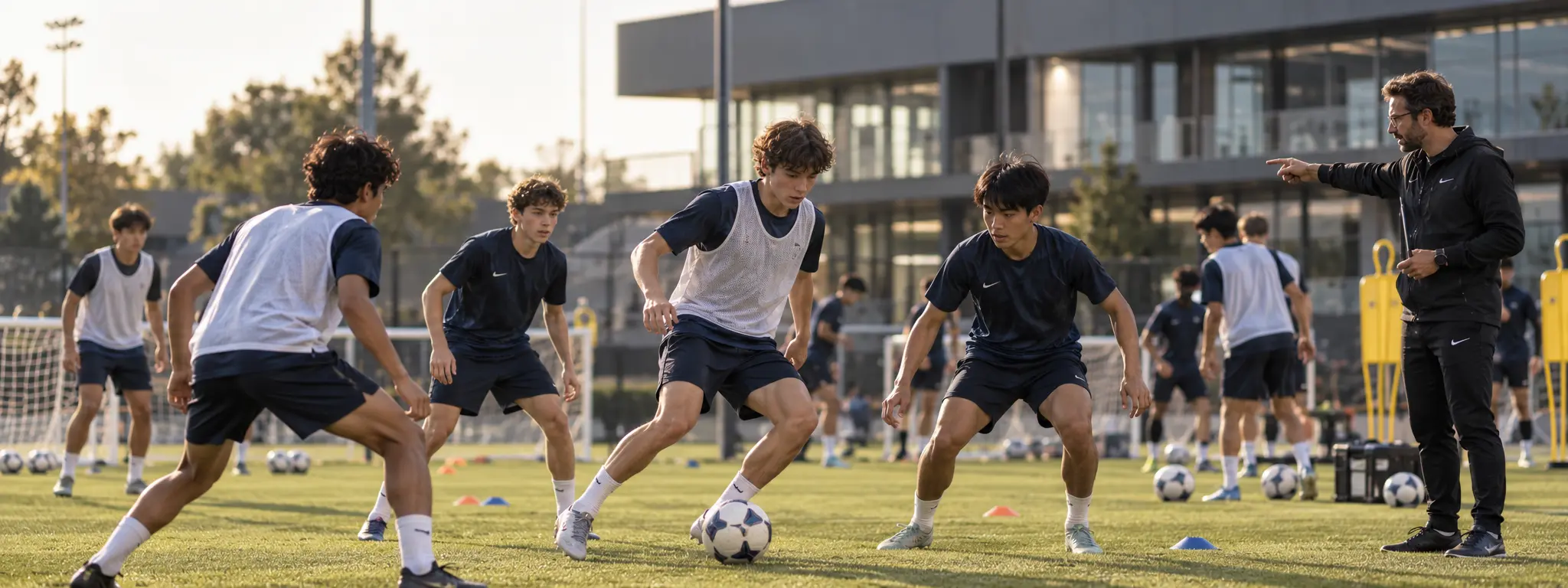
If you have ever wondered how professional football academies train players, the answer is more complex than running drills for a few hours every day. Elite academies build players through a combination of technical training, game-based practice, tactical education, physical development, performance analysis and personal development. The exact system differs by club, age group and football philosophy, but the common thread is that training is designed to help young players make better decisions in real match situations.
A 2020 study of 53 coaches and 83 training sessions across 16 professional youth academies in England, Germany, Portugal and Spain found that 62% of training time was spent in active decision-making activities, including small-sided and conditioned games, compared with 20% in non-active activities.
So, what actually happens inside an elite football academy?
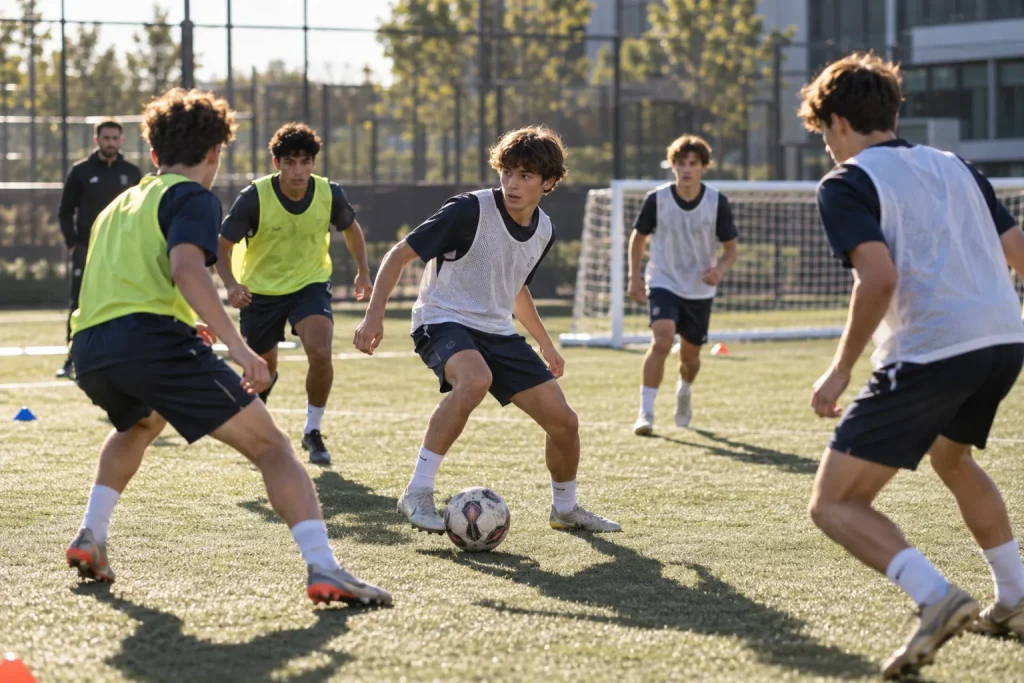
What do professional football academies actually train?
| Development area | What players work on |
| Technical | First touch, passing, receiving, dribbling, finishing |
| Tactical | Positioning, movement, pressing, build-up and transitions |
| Decision-making | Choosing when, where and how to pass, move or attack |
| Physical | Speed, strength, acceleration, endurance and recovery |
| Cognitive | Scanning, awareness, anticipation and reading the game |
| Psychological | Confidence, resilience, discipline and handling pressure |
| Professional skills | Nutrition, communication, media awareness and lifestyle |
The important point is that these areas are not trained independently. A player may practise passing, for example, while simultaneously learning to scan for pressure, recognise space and choose the right option.
That integration is one of the biggest differences between academy training and recreational football.
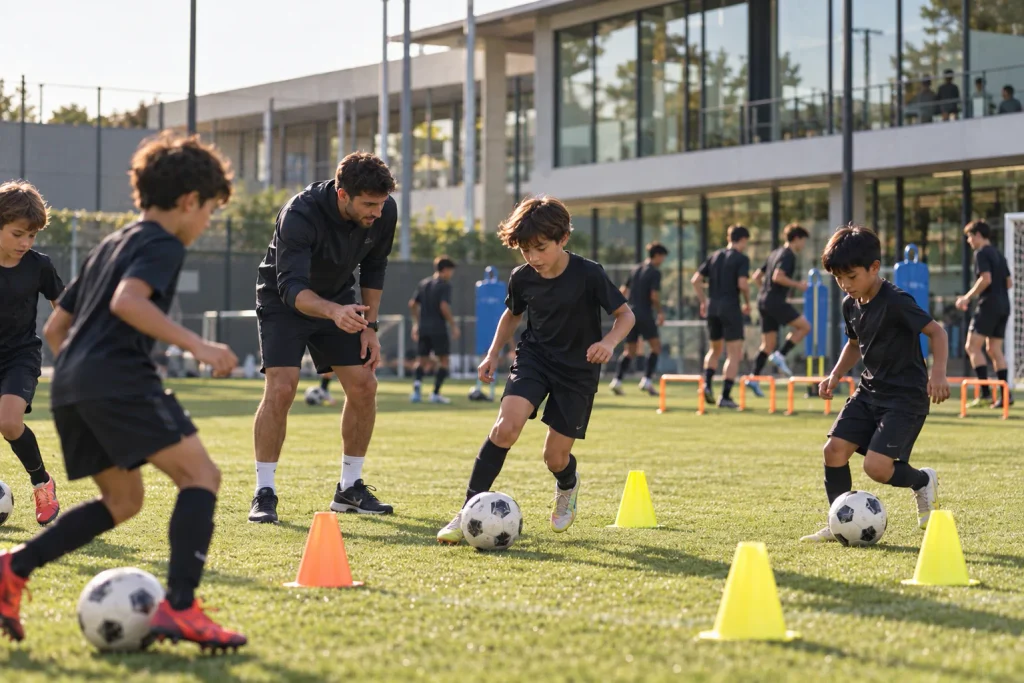
Why do academies use so many small-sided games?
One of the most important football academy training methods is the small-sided game.
Instead of always playing 11v11, coaches might create 3v3, 4v4, 5v5 or other modified formats. The pitch, number of players and rules can be changed to create a particular learning problem.
The reason is simple: fewer players generally mean more involvement.
A player has to receive the ball more often, look around more frequently, find passing options, react to opponents and make decisions under pressure.
Research published in Football Studies in 2026 examined how small-sided games are used by coaches from 13 highly productive European academies. The study describes them as a widely used method for developing both technical skills and tactical awareness.
This also explains why academy training can look surprisingly different from traditional drills. The objective isn’t simply to perform a movement correctly. It is to learn when that movement is useful.
What makes the Barcelona academy system different?
The Barcelona academy system, centred on La Masia, is particularly associated with a consistent football philosophy running through the youth structure.
FC Barcelona’s own methodology material describes training around collective and individual objectives, with an emphasis on improving players’ skills and decision-making. Its methodology also includes passing games, rondos, positional and situational games.
A rondo is the familiar possession exercise in which players keep the ball away from defenders inside a restricted area. But its value goes beyond passing accuracy.
Players have to:
- Scan before receiving.
- Adjust their body position.
- Identify passing lanes.
- Decide quickly.
- Move after releasing the ball.
- React immediately when possession changes.
That makes the exercise a compact environment for practising football intelligence.
FC Barcelona also describes its youth methodology as extending beyond football itself. La Masia supports players in academic, personal and professional development, rather than treating sporting performance as the only objective.
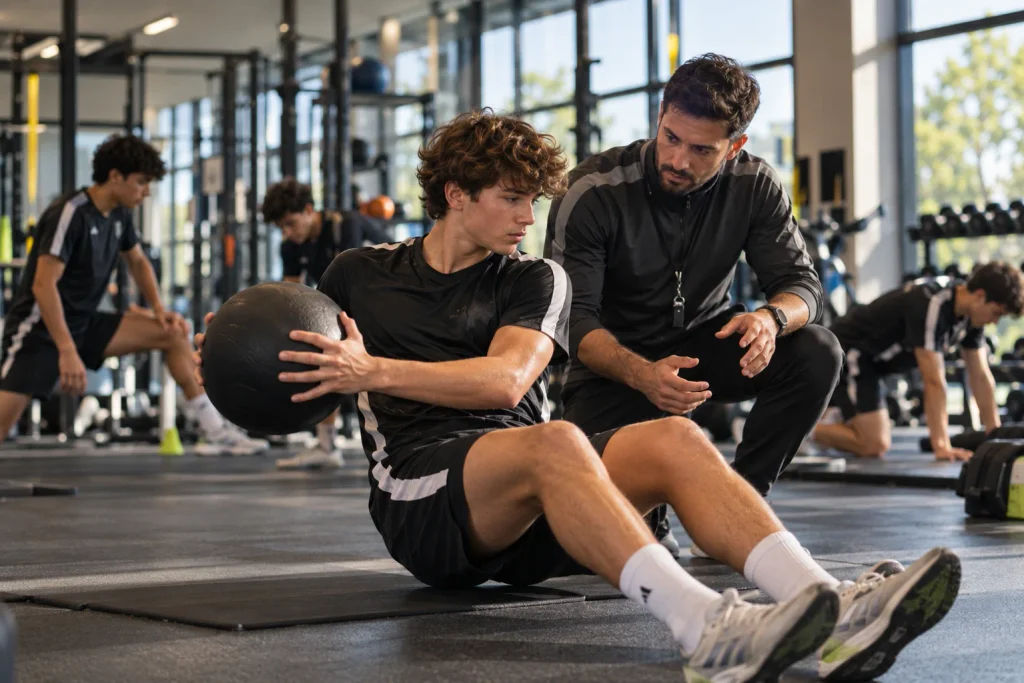
Do academy players spend most of their time doing fitness training?
Not necessarily.
Physical development is an important part of professional football, but when and how it is introduced depends on the player’s age, maturation and development stage.
A professional academy isn’t simply a senior team with younger players. Training loads and objectives change as players grow.
A 2025 study of adolescent players in a Premier League Category One academy notes that players in the 12–16 Youth Development Phase generally train around 8–12 hours per week, although schedules can increase with age. The programme studied also used different competitive formats, including bio-banding and futsal.
That distinction matters. Two players of the same chronological age can be at very different stages of physical maturation, so elite environments increasingly monitor the individual rather than assuming every player should receive the same workload.
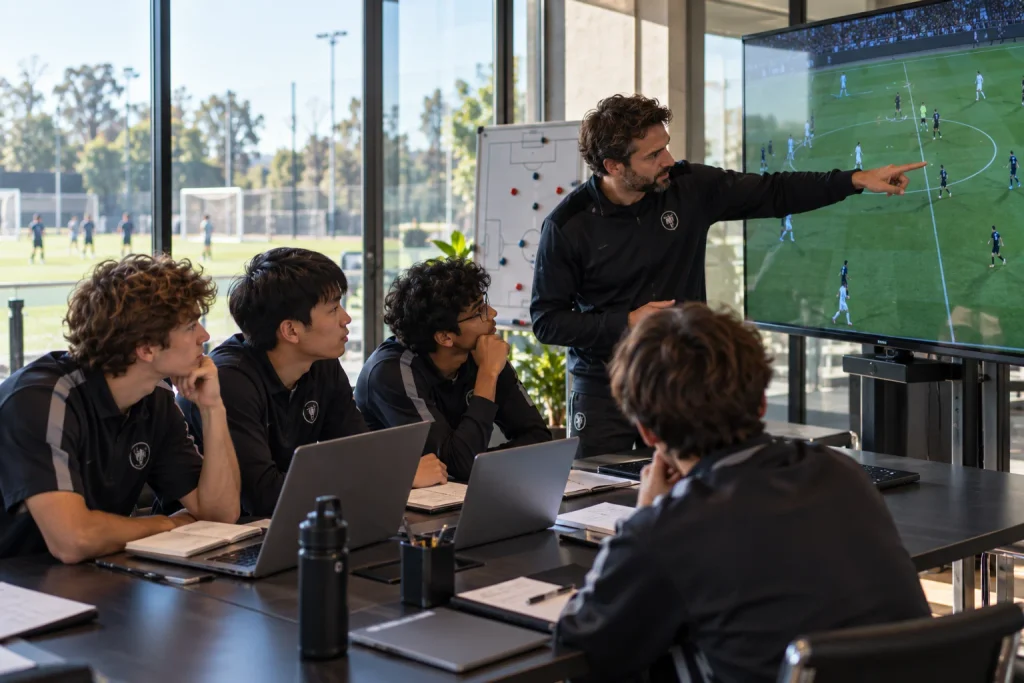
How are players taught to read the game?
This is where elite academy training becomes much more interesting.
A coach might create a training situation where a midfielder receives the ball with an opponent approaching from behind. The technical skill is passing. But the real lesson is everything that happens before the pass:
Where is the opponent? Where is the free player? Can I turn? Should I play one-touch? Is there space behind the defender?
The player is therefore training perception and decision-making alongside technique.
The European academy study found substantial use of small-sided and conditioned games, possession games and other activities involving active decisions.
This is why professional academies don’t simply ask, “Can this player pass?”
They ask:
“Can this player recognise the right pass, at the right moment, under pressure?”
Is training the same at every age?
No. Good academy systems progressively change the complexity of training.
Younger players need a strong foundation in ball control, coordination, movement and enjoyment. As players progress, training can introduce increasingly complex tactical problems, position-specific demands, physical preparation and performance analysis.
FC Barcelona’s youth programmes explicitly state that training objectives and complexity are adapted to the age and level of the players.
At the older end of the pathway, the education becomes broader still.
At La Masia, for example, players approaching professional football have received education around areas such as communication, media, finance, marketing and professional life.
The goal is not simply to create an excellent youth player.
It is to prepare someone for the demands of being a professional athlete.
How much does an academy’s philosophy matter?
A lot.
An academy isn’t just a collection of coaches and training pitches. The strongest systems create continuity between age groups so that players gradually develop within a recognisable footballing framework.
The long-term impact can be seen in player development. CIES Football Observatory’s 2025 analysis of the previous two decades found that 156 players trained by FC Barcelona went on to play in Europe’s five major leagues, second only to Real Madrid’s 166 in that particular measure. CIES defines a training club as the first club where a player spent at least three seasons between ages 15 and 21.
That doesn’t prove that one particular drill creates professional players. It does illustrate why academy systems are built around long-term development rather than weekend results.
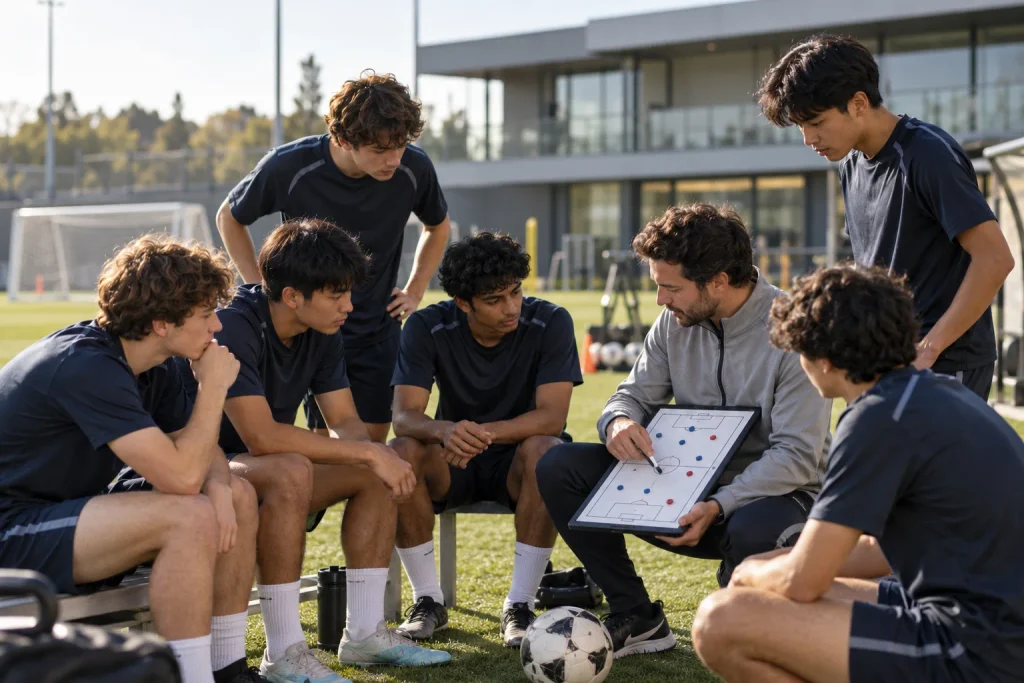
What can young footballers learn from professional academy training?
The biggest lesson is that elite training isn’t necessarily about doing more drills.
It is about making training more purposeful.
A strong session might give a player:
- A technical problem to solve.
- An opponent or constraint that makes the problem realistic.
- Repeated opportunities to make decisions.
- Feedback from the coach.
- A chance to apply the learning in a game.
- Reflection on what worked and what didn’t.
That cycle is far closer to professional development than simply repeating a perfect passing sequence without pressure.
And it explains why experiencing an academy environment can be valuable even when a young player has no intention of becoming a professional.
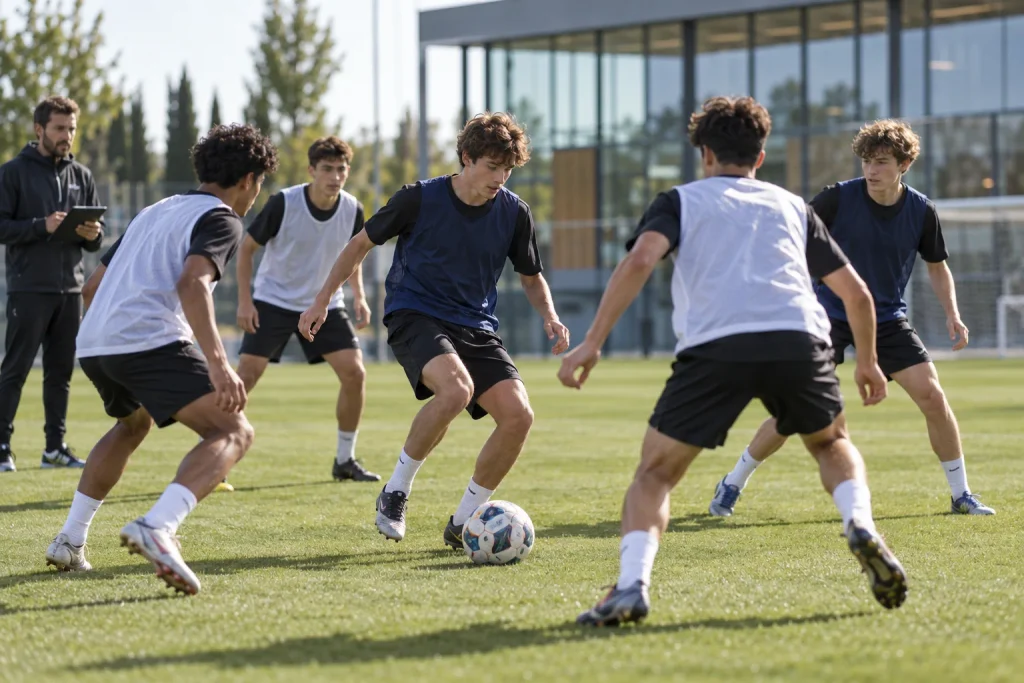
Can young Indian footballers experience this training environment?
Yes. An academy experience abroad isn’t the same as joining a professional club, and it shouldn’t be marketed as one.
Picknic’s football programmes currently include residential development experiences in Manchester and Barcelona. Its Manchester programme places players aged 10–16 inside Manchester United’s Soccer School for ten residential days, with technical drills, small-sided games and match play built around the club’s methodology. Its Barcelona option runs for fourteen residential days at Complex Esportiu La Báscula, led by a former FC Barcelona youth player, with language learning incorporated into the programme.
The useful part isn’t simply standing inside a famous stadium.
It is seeing how another football environment approaches training, coaching, discipline, decision-making and player development.
The real lesson behind elite football academies
There is no single secret Barcelona drill or universal professional academy formula.
Different academies use different philosophies, training structures and player-development models. What the strongest systems have in common is deliberate development: technical ability is connected to decision-making, physical preparation to individual development, and football training to life beyond the pitch.
That is what makes an academy different from simply attending football practice.
The player isn’t just being taught how to play football. They are being taught how to think, adapt and perform inside the game.
Continue Reading

International education trips can help students connect classroom learning with the world beyond it. By visiting universities, science centres, industries and cultural institutions, they can explore subjects in practical settings, ask questions about future pathways and experience different ways of living and working. The benefits of international education trips and career planning can include clearer […]

Speed was once a status symbol. Now, the most discerning travellers are choosing depth over distance — spending longer in fewer places and coming home richer for it. Here's how we design journeys that breathe.