


A visit to CERN can help students understand how scientists investigate the fundamental building blocks of matter, test theories about the universe and develop the complex technologies required for particle physics. Through exhibitions, guided tours and age-appropriate workshops, students can explore particle accelerators, detectors, antimatter and the relationship between theoretical predictions and experimental evidence. Located […]
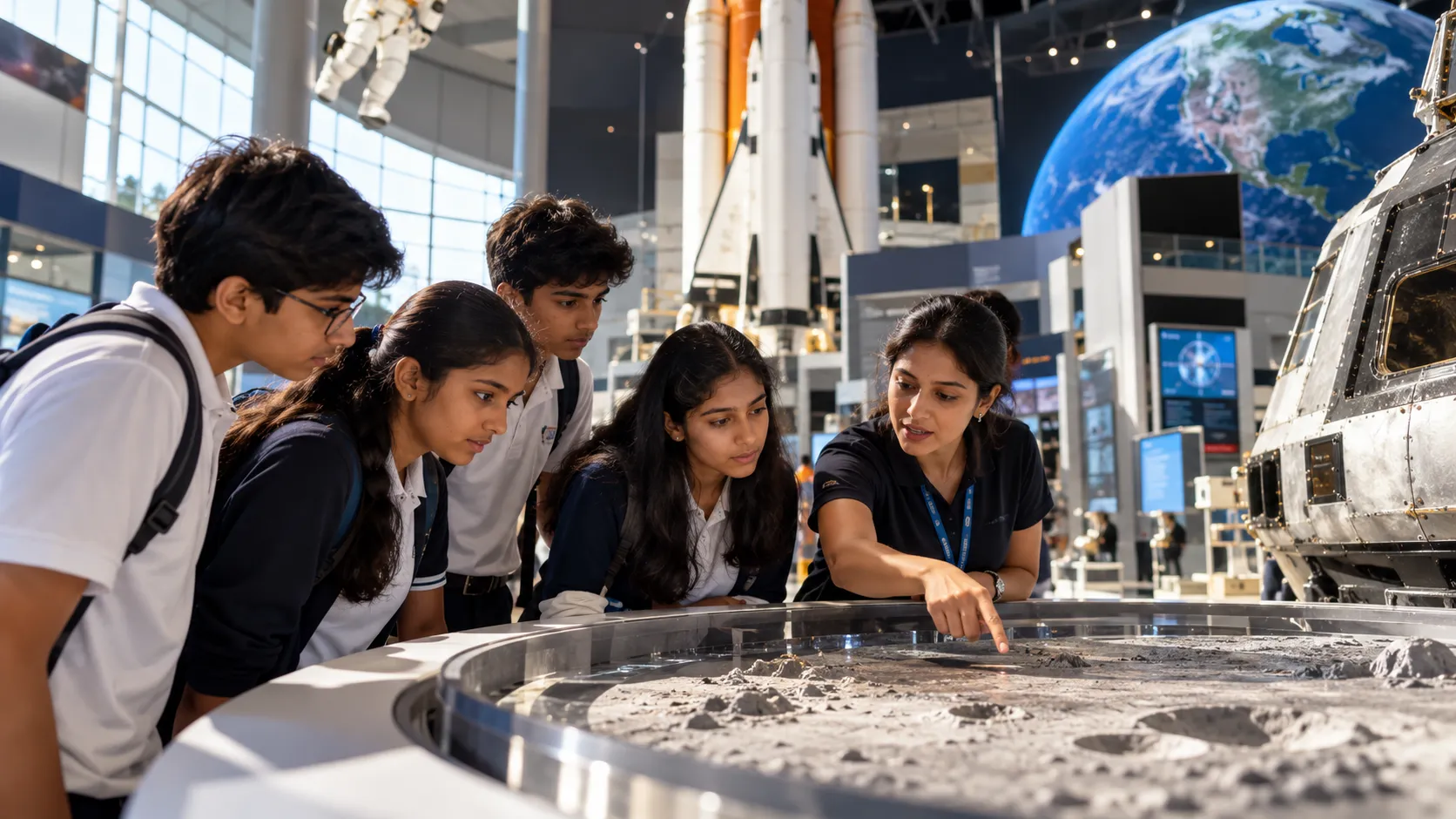
NASA education programs help students connect classroom science with real space missions, engineering challenges, Earth observation and scientific research. Depending on their age and the programme, students may investigate planetary environments, design and test engineering solutions, explore satellite data or work with mentors on research projects.
For school groups, an educational visit built around NASA-related facilities can make these subjects tangible. However, a visit to a space centre is different from participating in an official NASA internship or research programme.
For students interested in science, technology, engineering and mathematics (STEM), understanding these differences is the first step towards choosing an educational experience that delivers meaningful learning.
What are NASA education programs for students?
NASA offers educational resources and opportunities for learners across different stages of their academic journey. These include classroom resources, engineering challenges, research experiences, internships and activities designed to help educators introduce space science.
NASA’s STEM Gateway brings together opportunities such as internships, research, challenges, educator development and pre-college and college STEM experiences. Its resources cover subjects including Earth science, space science, engineering design, mathematics, technology and human space exploration.
The important distinction is that not every NASA educational opportunity involves travelling to a NASA facility. Some programmes are designed for classroom participation, while others require applications, specific qualifications or access to a designated institution.
For schools planning an international educational trip, the most relevant objective is often to create a structured encounter with the science and engineering behind space exploration, rather than to suggest that every student will enter a laboratory or work directly with NASA scientists.
What do students learn through NASA’s different educational opportunities?
1. Engineering design and problem-solving
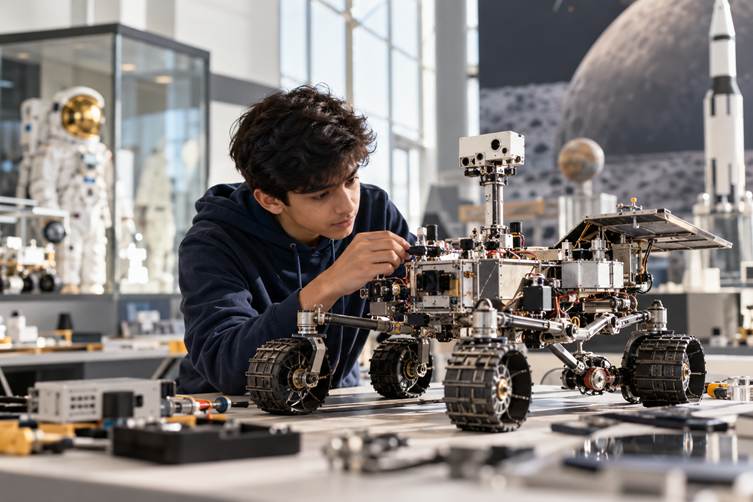
Space exploration presents engineering problems with unusually strict constraints. A rover must operate across uneven terrain, a spacecraft must function in an environment that humans cannot easily access, and equipment must be designed around limits on weight, power and reliability.
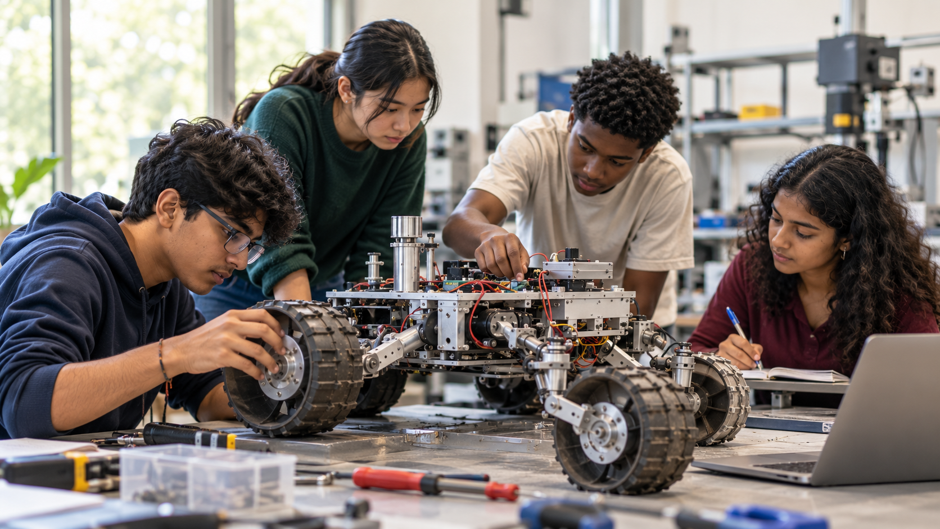
Educational activities based on these challenges help students understand how engineers translate a problem into a design. They can learn to identify requirements, build prototypes, test components, interpret failures and refine their solutions.
For example, a lunar rover design challenge can introduce questions about wheel traction, stability, energy consumption and remote operation. A robotic-arm exercise can demonstrate how movement, force, joints and control systems work together.
The educational value lies in the design process, not simply in producing a finished model. Students should be encouraged to explain why their solution works, what failed during testing and which changes improved the outcome.
2. Space science and planetary environments
NASA’s missions investigate planets, moons, stars, galaxies and the conditions that make environments suitable for scientific exploration. Students can use these missions to explore gravity, orbital motion, planetary geology, atmospheres and the evidence scientists use to understand distant worlds.
A lesson about Mars, for example, can connect geology with questions about water, climate and the possibility of past habitable environments. Studying lunar exploration can introduce surface conditions, landing systems and the challenges of operating in a low-gravity environment.
These topics also encourage students to distinguish between an observation and an interpretation. A photograph from a spacecraft is evidence, but understanding what it reveals requires scientific reasoning, comparison and an awareness of uncertainty.
NASA’s learner opportunities provide a useful starting point for exploring programmes across high school, undergraduate and graduate levels.
3. Earth observation and environmental science
Space education is not limited to looking beyond Earth. Satellites help scientists observe weather systems, oceans, forests, ice cover and changes in the atmosphere.
Students can explore how remote sensing works, why different instruments measure different properties and how scientists interpret observations collected over time. These activities connect physics and mathematics with geography, climate science and environmental studies.
A satellite-data exercise might ask students to compare images of a landscape across different dates or examine how measurements can reveal patterns that are difficult to observe from the ground.
This approach is particularly useful for interdisciplinary school programmes. Students can see that space technology supports practical work on Earth, from environmental monitoring to disaster response.
4. Research methods and scientific communication
Research-based opportunities teach students that science is a process of investigation rather than a collection of established facts. They may learn to formulate a question, select a method, examine evidence, document results and communicate their conclusions.
NASA’s official internship programmes offer a more advanced form of this experience. The NASA Internship Programs page describes Office of STEM Engagement (OSTEM) internships as project-based opportunities in which students work with NASA mentors. NASA states that its OSTEM programme provides more than 2,000 students annually with opportunities to contribute to the agency’s mission.
These internships have eligibility requirements and are not equivalent to a school tour. The learning principle, however, can inform school-trip preparation: students benefit when they arrive with a question to investigate and leave with evidence to discuss.
Are NASA internships and educational visits the same thing?
No. NASA internships are structured opportunities with formal application and eligibility requirements. An educational visit to a space centre, museum or related institution is a different experience.
This distinction matters when schools evaluate international science tours. A guided tour may explain launch infrastructure, spacecraft engineering or the history of exploration. A workshop may offer supervised construction or simulation activities. Neither automatically gives students access to restricted laboratories, operational control rooms or active research projects.
For Indian schools, the right programme depends on the age group, curriculum, travel budget and learning objectives. A school seeking introductory exposure may benefit from a guided aerospace visit combined with a hands-on engineering session. Older students considering STEM degrees may prefer a programme that includes technical briefings, university exposure or a carefully designed research-related activity.
Before confirming a programme, ask the organiser to specify which sessions are confirmed, which are demonstrations, whether students build or test anything themselves, and what access is subject to institutional approval.
How can schools turn a space-centre visit into measurable learning?
A successful educational tour starts before the flight. Teachers can introduce the engineering or scientific question that students will investigate and connect it to the relevant syllabus topics.
During the visit, students can record observations, sketch equipment, identify unfamiliar technical terms and prepare questions for guides or educators. A rover-focused session, for example, could ask students to identify the design constraints that would affect movement on the Moon.
After returning, students can produce a short engineering report, compare competing designs or present a research question to their classmates. These follow-up tasks make it easier to assess what students understood instead of relying only on whether they enjoyed the visit.
Schools should also agree on outcomes in advance. A physics department might prioritise forces, motion and energy, while a computer science group might focus on robotics, control systems or data interpretation. The same destination can serve different academic objectives when the preparation and reflection activities designed accordingly.
Which students benefit most from space agency student programs?
Space-related educational experiences can be adapted for different ages, but the programme should match the learner’s readiness.
Students in middle school may respond well to accessible demonstrations, model-building and introductory astronomy. Secondary-school students can engage with engineering trade-offs, planetary science and data interpretation. University students may be better suited to research placements, specialist workshops and formal internship opportunities, subject to eligibility.
A school should not select a programme only because its destination is famous. It should examine the actual learning activity, the time allocated to it and the connection to classroom work.
Teachers should also consider whether students will have enough time to ask questions and reflect. An itinerary packed with attractions can leave little room for scientific discussion, even if it includes a well-known space centre.
Planning a NASA-themed educational trip from India
International educational travel involves academic planning as well as logistics. Schools need to review passport and visa requirements, institutional booking rules, supervision arrangements, insurance, accessibility, accommodation and the time required for long-haul travel.
For programmes involving the United States, visa requirements and appointment availability should be checked through official channels well in advance. Access to particular facilities or educational sessions should never be assumed until it has been confirmed by the relevant institution.
Picknic’s NASA Space School at Kennedy programme describes a trip built around a three-day space-school experience featuring rover and robotic-arm builds, robotics activities and a guided facilities visit. The programme also includes wider travel experiences. Its page distinguishes astronaut presentations and Q&A sessions from private laboratory access.
For schools, this distinction is useful when evaluating the itinerary: the educational component should be understood in terms of the activities actually offered, not the reputation of the institution alone.
Picknic also lists broader educational travel programmes for schools, families and institutions. A programme can be discussed around the school’s preferred age group, subject focus and academic objectives.
Frequently asked questions
Can Indian students apply for NASA internships?
NASA’s main OSTEM and Pathways internship programmes have US citizenship requirements. NASA also describes an International Interns programme involving participating countries and formal institutional partnerships. Indian students should check the current eligibility conditions for the specific opportunity rather than assume that every NASA programme is open internationally.
Do students need to be studying science to visit a space centre?
No. A well-designed educational visit can suit students with different interests. Space exploration involves engineering, computing, mathematics, environmental science and communication. The best programme will match the activities to the students’ ages and learning goals.
What should teachers look for in a NASA-themed tour?
Look for clearly described activities, confirmed access, age-appropriate learning outcomes, qualified supervision and a connection to the curriculum. Ask whether the programme includes demonstrations, guided visits, practical workshops or research experiences, because these offer different levels of participation.
Does visiting a NASA facility guarantee interaction with astronauts?
No. Any astronaut presentation, Q&A or other interaction depends on the programme and its confirmed arrangements. It should be treated as included only when the organiser explicitly confirms it.
Give students a reason to look beyond the textbook
NASA education programmes show how scientific curiosity can develop into engineering practice and research. For schools, the strongest educational trip is one that gives students a specific question to investigate, a meaningful encounter with real science and an opportunity to explain what they learned.
Explore Picknic’s educational travel programmes or enquire about the NASA Space School at Kennedy to discuss a learning journey aligned with your students’ age group and academic objectives.
Continue Reading
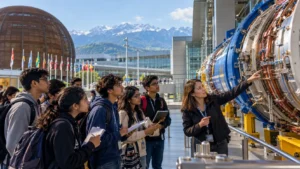
Europe is an excellent destination for science education tours because students can study scientific discoveries, explore interactive museums, encounter industrial engineering and visit institutions connected to contemporary research within the same trip. From the Deutsches Museum in Munich to CERN near Geneva, the continent offers opportunities to connect physics, chemistry, astronomy and engineering with the […]
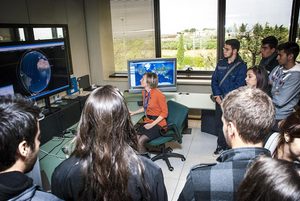
Space centers inspire students by turning abstract science into something they can observe, question and apply. When students encounter spacecraft, explore the engineering behind a mission or build a robotic model, subjects such as physics, mathematics, computing and engineering become more tangible. STEM education through travel works best when a visit is connected to classroom […]