


A traveller's account of doing the Uttarakhand Char Dham twice — once badly in June, once properly in September. Registration, health, helicopters and the stops packages drive past.
I am from Ranchi, which means I have crossed Bihar more times than I can count, mostly asleep, on the way to somewhere else. Last December I went there on purpose for eight days, and I have been slightly embarrassed about the previous forty years ever since.
Here is what is in that state, within a few hours of each other. The place where the Buddha attained enlightenment. The place where Mahavira attained nirvana. The birthplace of Guru Gobind Singh. The ruins of the university that taught the world for eight hundred years. The site of the First Buddhist Council. And, since July 2025, a stupa holding the Buddha’s own relic casket that I had never heard of and that almost no Indian traveller has.
Is Bihar safe for tourists, and what is actually there?
Bihar’s reputation lags its reality by about twenty years. The Buddhist circuit — Patna, Bodh Gaya, Rajgir, Nalanda, Vaishali — is well-travelled and well-policed, and the state recorded 6.62 crore tourist visits in 2025, including large numbers of foreign pilgrim groups. Ordinary Indian travel sense applies: don’t drive rural roads at night, use registered taxis, and remember Bihar is a dry state — do not carry alcohol in. The season is October to March; April to June is brutal and July to September is monsoon.
Buddhism: the part everybody knows, and the part nobody does
Bodh Gaya first, because you have to. The Mahabodhi Temple Complex, a UNESCO World Heritage Site since 2002, free to enter, open from five in the morning until nine at night. The Bodhi tree there is a descendant of the original, not the original.
What I had not expected was the streets around it. Bodh Gaya has monasteries built by Buddhist nations — Thailand, Japan, Bhutan, Tibet, Myanmar, Sri Lanka, China, Vietnam, Nepal, Cambodia, Korea, and more — each built in its own country’s architectural language, on the same few hundred metres of road. You walk from a Thai roofline into a Japanese one into a Bhutanese one. It is the only place in India where you can pass through a dozen national interpretations of a single faith in an afternoon.
And the town changes with the season. Between December and February, Bodh Gaya is not really an Indian town — Thai, Bhutanese, Burmese, Sri Lankan, Cambodian, Tibetan and Vietnamese pilgrims arrive in numbers, the monasteries run retreats, and the languages on the street change completely. You can read the pilgrimage calendar off the airport: Gaya has genuinely international flights — Bangkok, Paro, Yangon, Phnom Penh — and they are seasonal, running for the Buddhist winter.
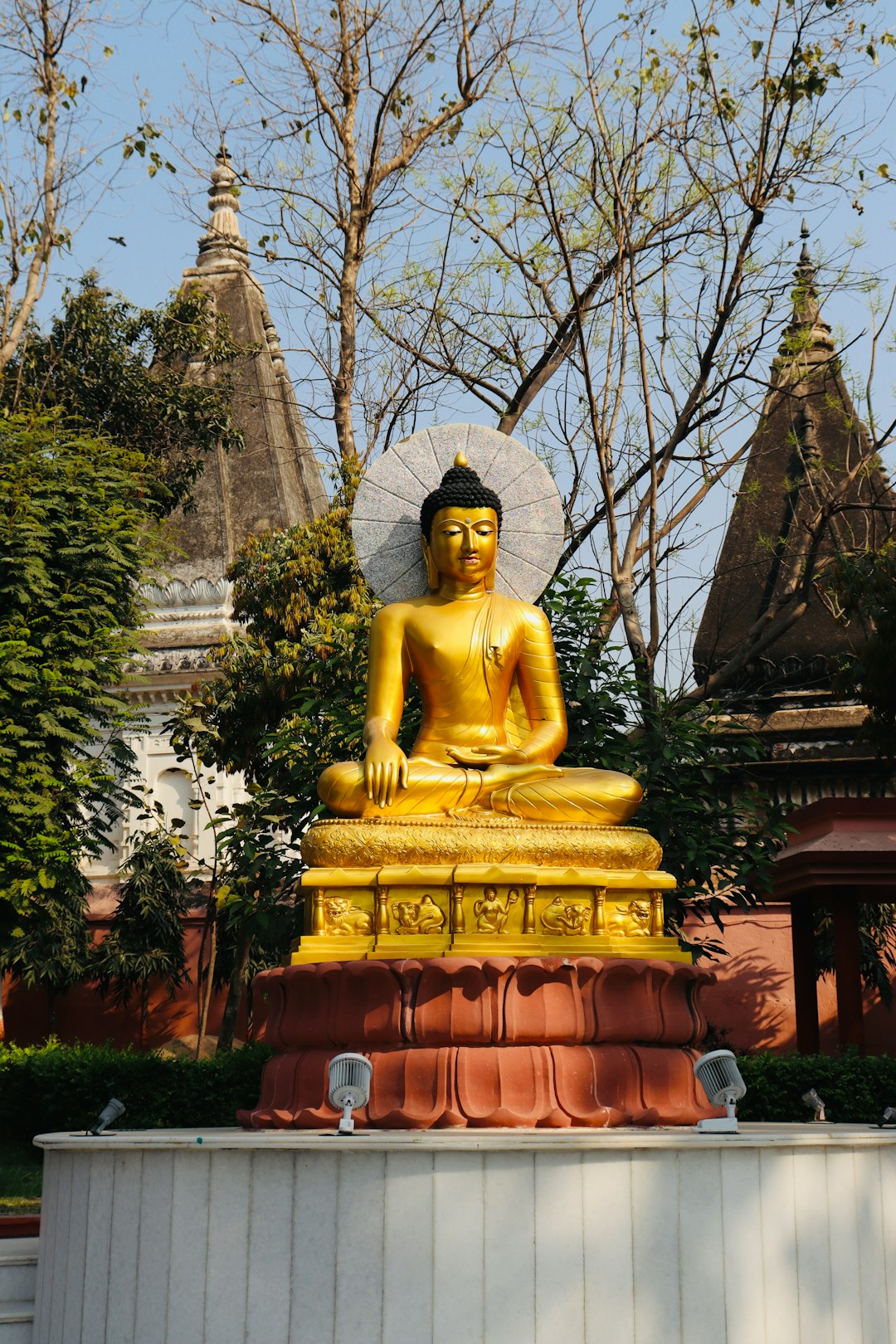
The Great Buddha statue is 18.5 metres, 80 feet with its plinth, consecrated by the Dalai Lama in 1989 after seven years and twelve thousand stonemasons. Inside, on shelves, are sixteen thousand three hundred small bronze Buddhas. Nobody tells you that. You have to go in.
Then Nalanda, a UNESCO site since 2016 — and here is a confusion worth clearing up before you travel. The new Nalanda University, inaugurated in June 2024, is at Rajgir, about twelve kilometres from the ancient ruins. Two different places with the same name. People book one and arrive at the other.
And Rajgir, which is where I would send anyone with an extra day. The Vishwa Shanti Stupa on Ratnagiri hill, built in 1969 by the Japanese Nipponzan-Myōhōji order, reached by an extraordinary single-seater chairlift — 2,200 feet, one person at a time, ₹80 round trip. You sit alone on an open chair and go up a hillside. There is now also an eight-seater cable car, and a staircase if you would rather.
But the site I keep thinking about is the Saptaparni caves, up a steep climb above the hot springs. This is where the First Buddhist Council was held after the Buddha’s death — where the teachings were first recited aloud and collected, which is the reason any of them survive. Arguably the most consequential spot in the entire Buddhist world. There was nobody there.
The thing that opened last year and nobody has told you about
Vaishali.
On 29 July 2025, the Buddha Samyak Darshan Museum and Memorial Stupa was inaugurated there. Seventy-two acres. Over five hundred and fifty crore rupees. Monks from fifteen countries at the opening.
On the first floor is the Asthi Kalash — the relic casket of the Buddha, recovered in the excavations of 1958 to 1962.
And the building itself: built entirely in stone, with no cement, no bricks and no concrete — 42,000 sandstone blocks joined by tongue and groove, earthquake-resistant, nearly twice the height of the Sanchi stupa.
I stood in front of it for a long time trying to work out why I had never heard of it. It is the single most significant new Buddhist structure in India and it opened a year ago, in a state most Indians drive through.
If you have a further day, Kesaria, 110 km from Patna in East Champaran, is a 32-metre stupa from roughly the Ashokan period, with terraces that echo Borobudur, ASI-protected and — in the ASI’s own condition — largely overgrown. It is often claimed as the tallest Buddhist stupa in the world, which depends entirely on how you measure. What is not in dispute is that a two-thousand-year-old structure the size of a hill sits in a field with no ticket queue.
Jainism: which is not a side trip
I had thought of Bihar as a Buddhist state with some Jain sites in it. That is backwards. Mahavira was born, attained enlightenment and attained nirvana within this state. It is the Jain heartland.
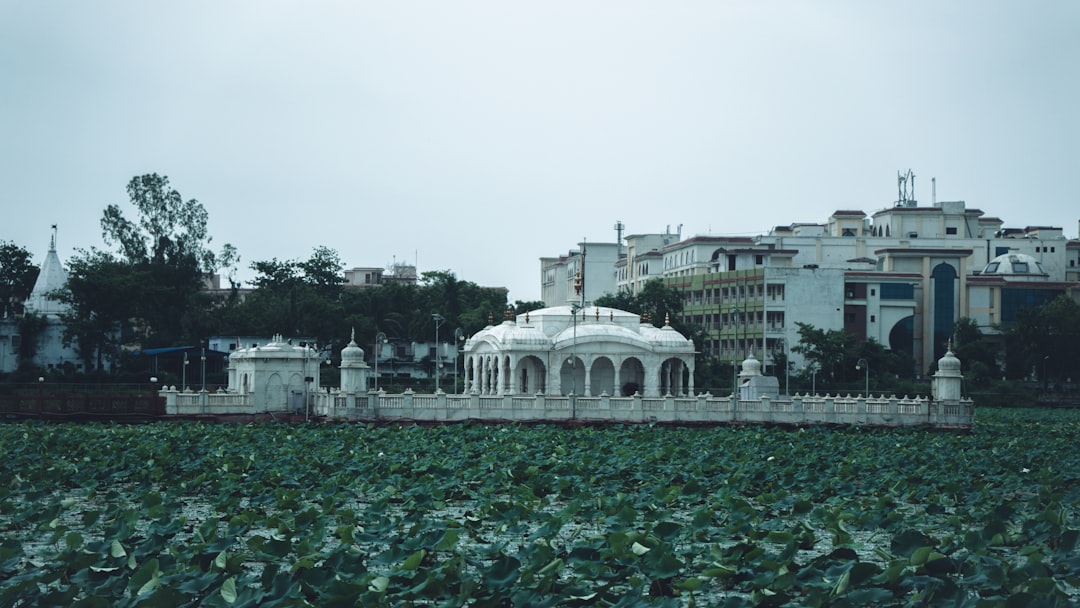
Pawapuri is where he attained nirvana, traditionally in 527 BCE. The Jal Mandir is a white marble temple standing in the middle of a lotus tank, reached by a long stone causeway, built on the site of his cremation — and the tradition is that the tank exists because devotees carried away so much earth from the cremation ground as relic that the depression filled with water.
I went at seven in the morning in December with mist coming off the tank and it is, without qualification, one of the most beautiful things I have seen in India.
And a connection I had never made: Jains observe Diwali as the anniversary of Mahavira’s nirvana, and Pawapuri is the focal point of it. I had celebrated Diwali my entire life without knowing that a few hundred kilometres away it means something completely different to somebody else.
On his birthplace, I will not adjudicate, because it is a live question between traditions. Digambara pilgrims go to Kundalpur near Nalanda; Shvetambara pilgrims and most historians point to Basokund near Vaishali. Both are a day trip from Patna, and the disagreement is part of the story rather than a problem with it.
Sikhism: a childhood, walkable
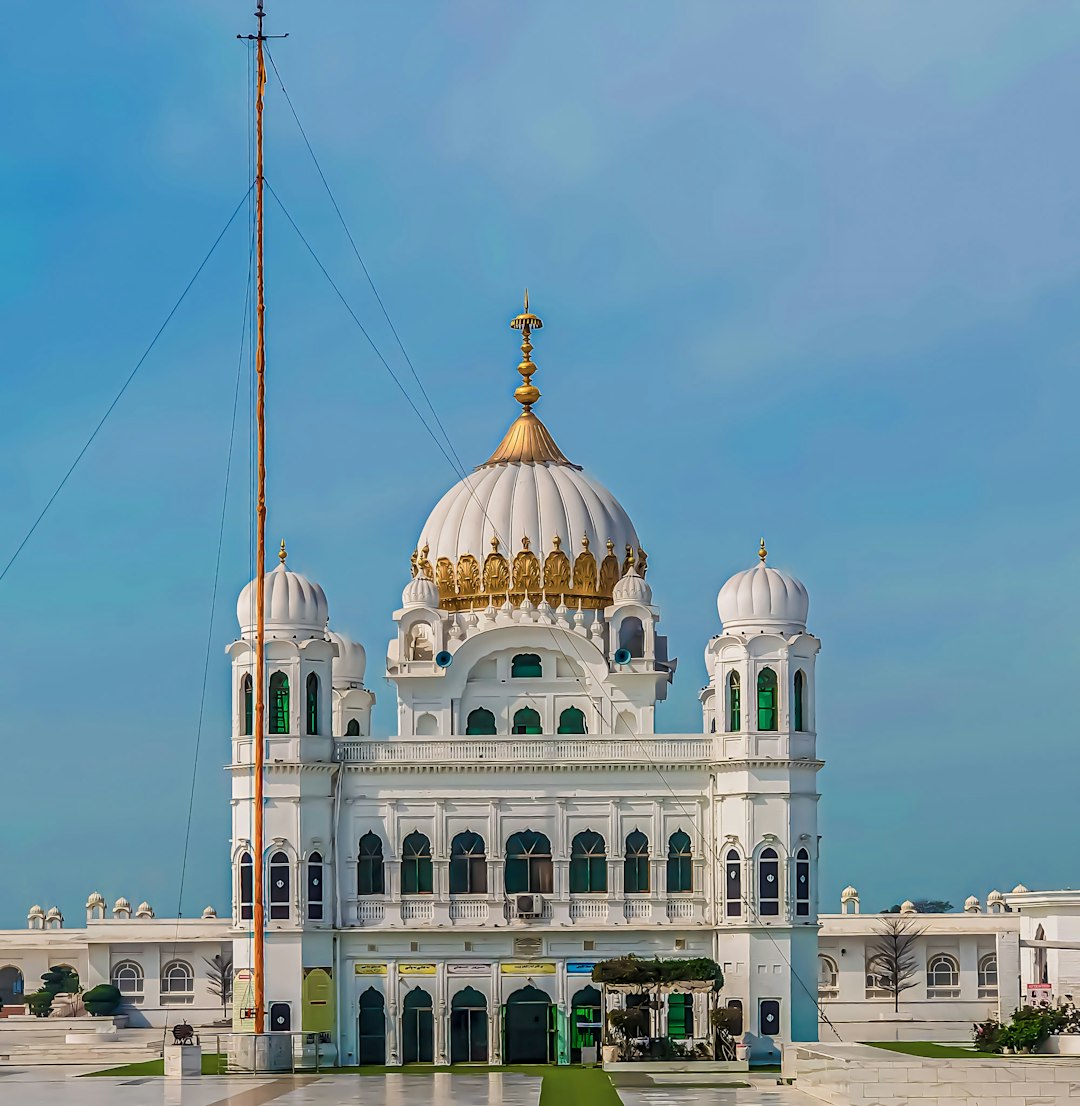
Takht Sri Harmandir Ji, Patna Sahib is one of the five Takhts of Sikhism and the birthplace of Guru Gobind Singh, born here in 1666. The present domed structure owes much to a rebuilding under Maharaja Ranjit Singh and a later reconstruction after the 1934 Bihar earthquake damaged it. Open long hours, free langar, open to all, head covered, shoes off.
What I did not know until I was there is that the other gurdwaras nearby make a walkable route through a seventeenth-century childhood. Gurdwara Bal Leela Maini Sangat, the house where the child Gobind Rai played. Gurdwara Gobind Ghat on the Ganga, where he is said to have thrown his bangle into the river. Gurdwara Pahila Bara, connected with Guru Nanak’s visit. Gurdwara Guru Ka Bagh, where Guru Tegh Bahadur was received on his return and, tradition says, first saw his son.
They are all within a small radius of Patna City — the old eastern part, not the new town — and doing them on foot in a morning is a completely different experience from being driven to one of them.
If you want the scale of it: Prakash Parv, Guru Gobind Singh’s birth anniversary, falls in mid-January 2027 — I have seen 15 and 20 January quoted and would confirm with the Takht — and it is the busiest week of the year at Patna Sahib by a distance. Book very far ahead or deliberately avoid it.
The two weeks not to go, and nobody writes this down
Pitru Paksha 2026 runs from 26 September to 10 October.
Gaya is the site for pind daan — the belief being that rites performed there liberate one’s ancestors permanently — and during that fortnight the Gaya Pitru Paksha Mela draws lakhs of pilgrims from across India and abroad. Accommodation in Gaya and Bodh Gaya becomes effectively unavailable, roads are diverted, and the Vishnupad temple has multi-hour queues.
If you are going for Hindu shraddh rites, that fortnight is the only time. If you are going for the Buddhist circuit, it is the worst two weeks of the year to be there. The two calendars sit on top of each other in the same small town and I have not seen a single guidebook mention it.
One more thing, in Patna
The Bihar Museum is one of the best-designed museums in India and it is in the city everybody flies through without stopping. Closed Mondays, galleries ten to five, ₹100 for an Indian adult and half price after five in the evening. The Didarganj Yakshi is there — the Mauryan-polish sandstone figure, one of the most celebrated objects in Indian art. The building is worth the visit on its own.
What I would tell you
Go between October and March, and if you want to see Bodh Gaya at its most extraordinary, go in December or January when the international pilgrims are in. Avoid 26 September to 10 October 2026. Give it eight days rather than four. Do Patna City on foot. Climb to Saptaparni. And go to Vaishali, because there is a stupa there holding a relic casket of the Buddha that opened last year and nobody in your family has heard of it either.
Frequently asked questions
How many days do I need for the Bihar circuit?
Six to eight to do it without rushing. A tight version is Patna (1) – Vaishali (1) – Rajgir and Nalanda (2) – Bodh Gaya (2). Add a day for Pawapuri and Kundalpur if the Jain sites matter to you, and a further day for Kesaria in East Champaran, 110 km from Patna. Patna to Bodh Gaya, Patna to Rajgir and Bodh Gaya to Rajgir are each roughly two to three hours on good highway; the rural approaches to Kesaria and the smaller sites are considerably slower than a map suggests.
When is the best time to visit Bihar, and when should I avoid it?
October to March. April to June is brutally hot and July to September is monsoon. December to February is the most interesting window at Bodh Gaya, when international Buddhist pilgrims arrive in numbers and Gaya airport runs its seasonal flights to Bangkok, Paro, Yangon and Phnom Penh. Avoid 26 September to 10 October 2026 — Pitru Paksha, when the Gaya Mela fills every room in Gaya and Bodh Gaya and diverts the roads. Also avoid mid-January at Patna Sahib unless you are going for Prakash Parv itself.
What is the new stupa at Vaishali?
The Buddha Samyak Darshan Museum and Memorial Stupa, inaugurated on 29 July 2025 — 72 acres, over ₹550 crore, with monks from fifteen countries present at the opening. Its first floor holds the Asthi Kalash, the relic casket of the Buddha recovered in excavations between 1958 and 1962. The structure is built entirely in stone with no cement, bricks or concrete — 42,000 sandstone blocks joined by tongue and groove — and stands nearly twice the height of the Sanchi stupa. It is the most significant new Buddhist structure in India and remains largely unknown to Indian travellers.
Where was Mahavira born — Kundalpur or Vaishali?
Genuinely disputed between traditions, and not something a traveller should try to settle. Digambara pilgrims go to Kundalpur near Nalanda, where a temple complex marks the site. Shvetambara pilgrims and much mainstream scholarship point to Basokund near Vaishali, on the reading that Kundagrama was a suburb of Vaishali. Both are within a day trip of Patna. What is not disputed is Pawapuri, where Mahavira attained nirvana and where the Jal Mandir stands in its lotus tank — and where Jains mark Diwali as the anniversary of that nirvana.
Is Nalanda University the same as the Nalanda ruins?
No, and this catches people out. The ancient Nalanda Mahavihara — the archaeological site, a UNESCO World Heritage Site since 2016 — and the new Nalanda University campus, inaugurated in June 2024, are about twelve kilometres apart, the new campus being at Rajgir. If you want the ruins of the university that ran for roughly eight hundred years until its destruction around 1193, you want the archaeological site, not the campus.
Is Bihar safe to travel in?
The Buddhist circuit is well-travelled and well-policed, and the state recorded 6.62 crore tourist visits in 2025, including substantial numbers of foreign pilgrim groups moving in organised parties. Its reputation is largely formed from the 1990s and is substantially out of date for these routes. Standard Indian travel sense applies: don’t drive rural roads after dark, use registered transport, and note that Bihar is a dry state — do not carry alcohol in. Bihar Tourism publishes official travel guidelines, which are a better guide than anecdote.
Our Bodh Gaya and Rajgir journey can be extended to take in Vaishali and Pawapuri rather than treating them as detours, and travellers following the wider Buddhist and Hindu axis usually pair it with Kashi and Varanasi.
At the thumbprint, say which of the three traditions you are travelling for — or whether, like me, you want all of them in one week. It is a different itinerary each way.
Continue Reading
A Lucknow traveller on the 22 theerthams, the ₹25 ticket nobody tells you about, the new Pamban bridge, and the night ceremony at Meenakshi that changed the trip.