


A visit to CERN can help students understand how scientists investigate the fundamental building blocks of matter, test theories about the universe and develop the complex technologies required for particle physics. Through exhibitions, guided tours and age-appropriate workshops, students can explore particle accelerators, detectors, antimatter and the relationship between theoretical predictions and experimental evidence. Located […]
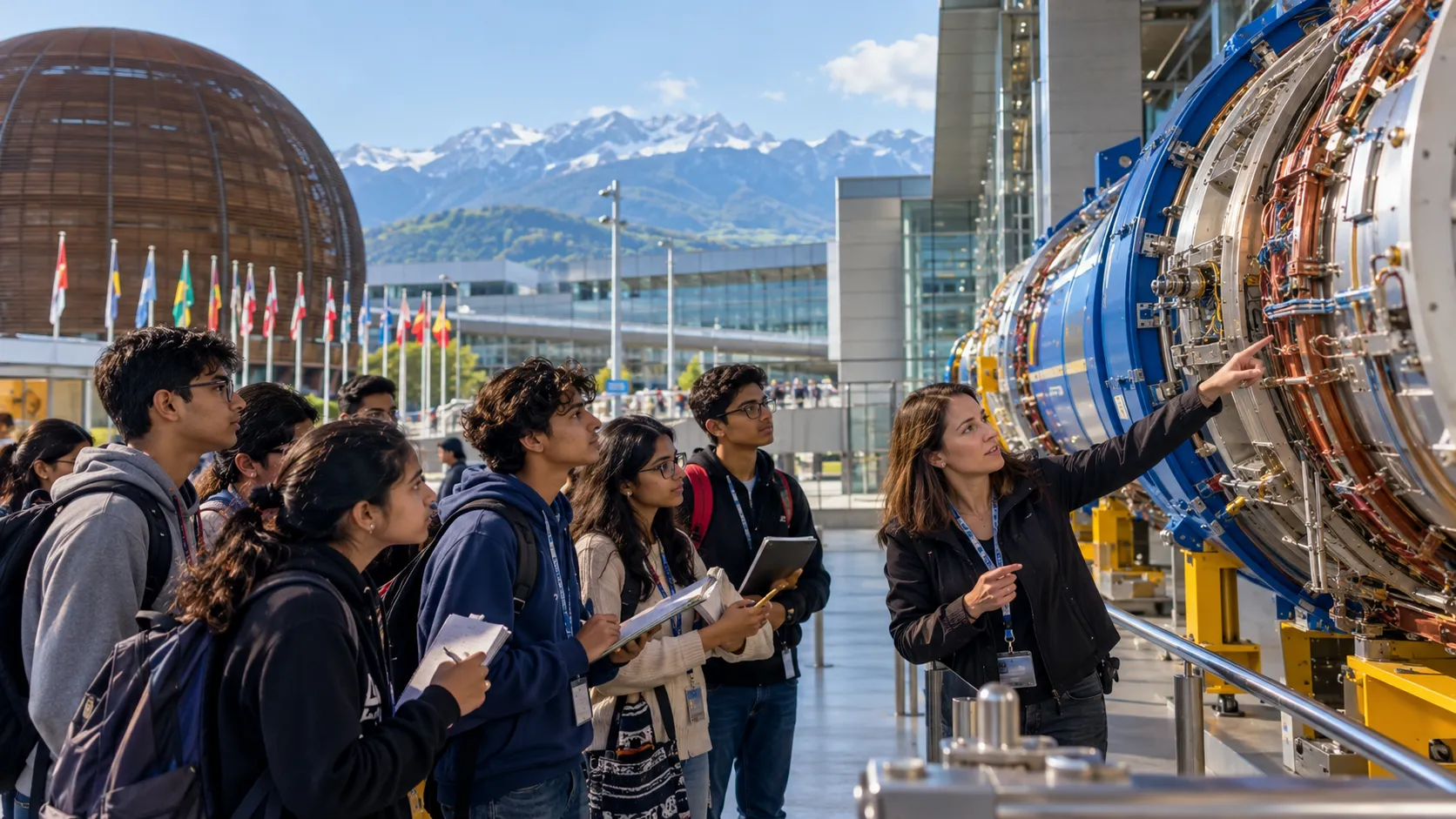
Europe is an excellent destination for science education tours because students can study scientific discoveries, explore interactive museums, encounter industrial engineering and visit institutions connected to contemporary research within the same trip. From the Deutsches Museum in Munich to CERN near Geneva, the continent offers opportunities to connect physics, chemistry, astronomy and engineering with the history of scientific thought.
For schools, this makes Europe especially useful when the objective is to take learning beyond a single subject. A carefully planned tour can show students how scientific ideas develop, how technologies are applied and how research institutions contribute to modern society.
The key is to choose destinations around a clear academic objective rather than attempting to cover as many countries as possible.
What makes European science museums valuable for students?
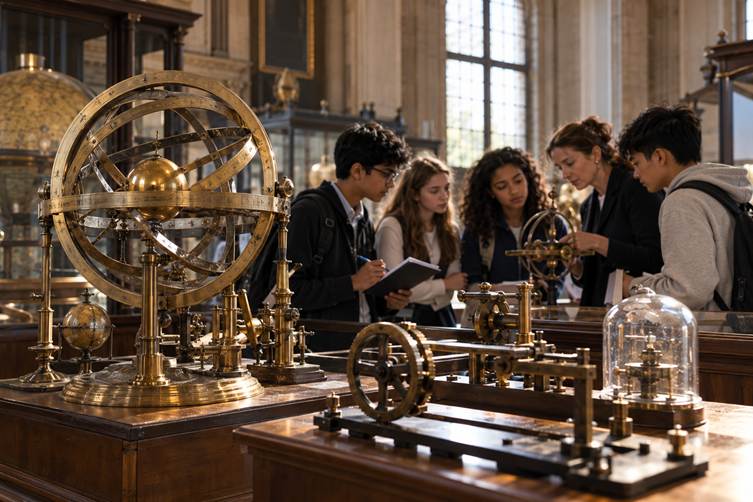
European science museums offer students an opportunity to encounter scientific concepts through physical objects, demonstrations, historical instruments and, where available, practical activities.
The Deutsches Museum in Munich provides educational programmes, guided tours and workshops for school groups. Its collections and educational activities cover subjects across science and technology, including chemistry, transport, energy and communication.
This kind of visit can make an abstract classroom topic easier to understand. A student studying electricity, for example, can connect theoretical principles with actual equipment and demonstrations. Someone studying mechanical engineering can investigate how machines have changed over time.
Museums also help students recognise that scientific knowledge develops through experimentation, observation and revision. Historical instruments provide evidence of how earlier researchers approached questions with the technology available to them.
The educational value depends on preparation. Teachers should identify relevant exhibitions, arrange suitable group activities and give students questions to investigate before arriving.
Which European destinations are particularly useful for science education?
1. Munich, Germany: Engineering, technology and scientific collections
Munich is a strong choice for students interested in engineering and applied science. The Deutsches Museum offers exhibitions and educational activities covering a broad range of scientific and technological subjects.
Its school programmes include guided tours, workshops and resources teachers can use before and after a visit. Certain activities allow students to investigate science through practical work rather than observation alone.
A visit can be tailored around a particular subject. Physics students might explore energy, mechanics or optics, while chemistry students may benefit from laboratory-related educational activities where available.
Teachers should check the current programme and reserve suitable sessions ahead of travel. The museum advises schools to plan their visit carefully because the site is extensive, and group activities may require advance arrangements.
Munich can also be combined with industrial engineering visits in Germany, creating an itinerary that connects scientific principles with how products and systems are developed.
2. Geneva, Switzerland: Particle physics at CERN
CERN offers a different perspective on science education. Rather than focusing primarily on historical objects, it introduces visitors to questions at the frontiers of particle physics.
The CERN Science Gateway features exhibitions including Discover CERN, Quantum World and Our Universe, alongside science shows, guided tours and laboratory workshops depending on availability.
Students can explore how researchers investigate fundamental particles and study the forces governing matter. The experience can connect school physics with accelerator technology, detectors, computing and international scientific collaboration.
CERN is particularly relevant for older students studying physics, although its interactive exhibitions also provide accessible entry points for younger learners.
Planning is essential. CERN’s group visits are free, but school and university groups must register through the official process. Availability is limited, and some activities have age requirements. Schools should not assume that an underground accelerator tunnel or a working laboratory will be part of a visit.
3. London, United Kingdom: Science, aviation and the history of technology
London offers opportunities to explore scientific developments alongside the historical context in which they emerged. Its museums can support learning across physics, engineering, computing, medicine and aviation.
The Science Museum is a useful starting point for teachers planning a science-focused itinerary. Its collections can help students investigate how scientific instruments, machines and technological systems have changed over time.
A museum visit is particularly valuable when students compare the technology available to earlier generations with modern applications. They can consider how improvements in measurement, materials and computing changed what scientists and engineers were able to accomplish.
For schools, the practical task is to select exhibitions that align with the curriculum and check the current availability of school sessions, guided tours and learning resources before booking.
4. Paris, France: Mathematics, optics and the development of scientific ideas
Paris can support a science tour that connects scientific history with mathematics, astronomy, physics and engineering.
Students can examine how scientific ideas develop within particular historical settings and how measurement and observation contribute to new explanations of the natural world. Museums, scientific collections and historic sites can provide a starting point for discussions about the development of instruments and scientific methods.
The city also offers opportunities to examine engineering in the built environment. Structural design, materials, geometry and the movement of people through large urban spaces can all become subjects for observation.
For a school group, the most useful approach is to create a specific investigation. Students might examine the engineering principles behind a structure or compare historical scientific instruments with modern methods of measurement.
5. Stuttgart, Germany: Automotive engineering and applied physics
Stuttgart is particularly relevant for students interested in mechanical engineering, industrial design and mobility. The Porsche and Mercedes-Benz museums provide ways to study the development of automotive technology through vehicles, engineering systems and design evolution.
A guided museum visit can connect classroom topics such as motion, friction, aerodynamics, materials and energy efficiency with real products.
Picknic’s Europe STEM and Culture programme includes visits to the Porsche and Mercedes-Benz museums, a BMW-related industrial visit in Munich, CERN and other European experiences. The programme describes these as guided tours and visitor sessions, rather than promising laboratory classes at every institution.
This clarity is important for schools. An industrial tour can provide meaningful insight into engineering without granting access to confidential manufacturing processes or restricted operational areas.
How do historical scientific sites improve classroom learning?
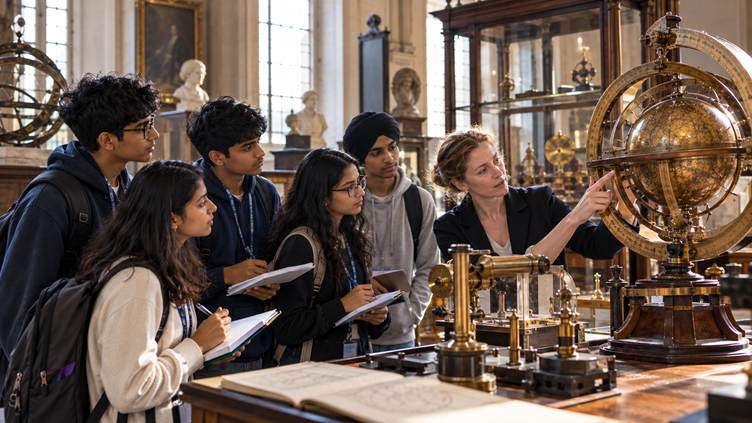
Historical scientific sites allow students to study science as an evolving human activity. Instead of treating scientific knowledge as a fixed collection of facts, students can investigate how people developed explanations, built instruments and tested ideas in different periods.
Consider a lesson on astronomy. Students can compare early observational instruments with modern telescopes and satellite-based observations. In physics, the history of measurement can help explain why accurate instruments matter. In chemistry, historic laboratory equipment can prompt discussion about changes in experimental methods and safety.
These visits are also useful for understanding the relationship between science and society. Scientific discoveries influence industry, medicine, transport and public policy, while social needs and available technology affect which research questions receive attention.
Teachers can make the connection explicit by asking students to record a historical object, identify the problem it was designed to solve and explain how a modern equivalent might work differently.
How should schools plan a European science education tour?
A science tour should begin with a learning brief. Teachers should define the subjects students are studying, the age group, the desired outcomes and the amount of time available.
Once those are clear, the itinerary can be built around a few complementary experiences. For example, a physics-focused programme could combine a museum visit with CERN, while an engineering-focused tour might pair technical collections with automotive museums and a confirmed industrial visit.
Transport time matters. Crossing several countries can consume valuable hours and leave students too tired to engage with the educational sessions. A geographically sensible route with sufficient time at each institution is generally more useful than an itinerary that adds destinations simply to increase the number of stops.
Schools should also confirm:
- Whether visits are guided, self-directed or workshop-based.
- The age limits and group-size rules for each activity.
- Whether advance reservations are required.
- The availability of teaching materials or pre-visit resources.
- Accommodation, transport, insurance, accessibility and supervision arrangements.
- The passport and visa requirements applicable to every traveller.
CERN illustrates why advance planning matters. Its official group-visit information states that group registration is mandatory, can be made up to nine months in advance and is subject to availability. School and university groups must submit requests using an official institutional email address.
This requirement should be addressed before travel arrangements are finalised.
What should students do before, during and after the tour?
Before departure, teachers can introduce the questions that will guide the trip. Students could research a scientific discovery, prepare questions for a museum educator or review the principles behind a planned demonstration.
During each visit, students should record observations rather than simply collect photographs. A worksheet might ask them to identify the scientific principle behind an exhibit, describe a technological challenge or explain how a historical instrument differs from a modern one.
After returning, students can prepare short presentations, technical reports or subject-specific reflections. These activities give teachers a clearer basis for evaluating the educational value of the experience.
A useful assessment question is: can the student explain something more accurately or independently after the trip than before it?
That question helps schools distinguish a science education tour from a conventional sightseeing itinerary.
Why choose a curated science tour instead of planning every stop independently?
Independent planning gives schools control over individual bookings, but a multi-country science itinerary involves coordinating institutions with different booking rules, opening schedules, educational formats and transport requirements.
A curated programme can help bring these elements together around a defined subject or age group. The school should still review each component carefully and request a clear breakdown of confirmed activities, costs, supervision and academic outcomes.
Picknic’s educational travel programmes are designed for schools, universities and families seeking structured learning journeys. Its Europe STEM and Culture itinerary offers a starting point for institutions interested in engineering, scientific history and CERN.
Frequently asked questions
Which European country is best for science education tours?
The best country depends on the curriculum. Germany is useful for engineering and technology, Switzerland for CERN and particle physics, and the United Kingdom and France for museum-based science learning and scientific history. A multi-country itinerary can work when travel time supports the educational objectives.
Is CERN suitable for school students?
Yes, subject to the activities available and the students’ ages. CERN offers interactive exhibitions and other educational experiences, while guided tours and workshops have specific eligibility and booking requirements.
How early should schools plan a European science tour?
Begin planning well ahead of the intended departure, especially if the itinerary includes CERN or other high-demand institutions. Confirm institutional visits before committing to non-refundable travel arrangements wherever possible.
Can a European science tour include engineering and cultural experiences?
Yes. The strongest interdisciplinary itineraries connect technical learning with the history, architecture and industrial context of the places students visit. These elements should complement the academic focus rather than crowd out the learning sessions.
Turn European science into an experience students can explain
Europe’s science museums, engineering collections and research institutions can help students connect classroom concepts with real objects, technologies and scientific questions. The most effective tour is one built around a clear curriculum objective, realistic travel planning and activities that students can reflect on after returning home.
Explore Picknic’s Europe STEM and Culture programme or browse its educational travel programmes to discuss a science education tour suited to your students.
Continue Reading
NASA education programs help students connect classroom science with real space missions, engineering challenges, Earth observation and scientific research. Depending on their age and the programme, students may investigate planetary environments, design and test engineering solutions, explore satellite data or work with mentors on research projects. For school groups, an educational visit built around NASA-related […]
Space centers inspire students by turning abstract science into something they can observe, question and apply. When students encounter spacecraft, explore the engineering behind a mission or build a robotic model, subjects such as physics, mathematics, computing and engineering become more tangible. STEM education through travel works best when a visit is connected to classroom […]