

Europe is an excellent destination for science education tours because students can study scientific discoveries, explore interactive museums, encounter industrial engineering and visit institutions connected to contemporary research within the same trip. From the Deutsches Museum in Munich to CERN near Geneva, the continent offers opportunities to connect physics, chemistry, astronomy and engineering with the […]
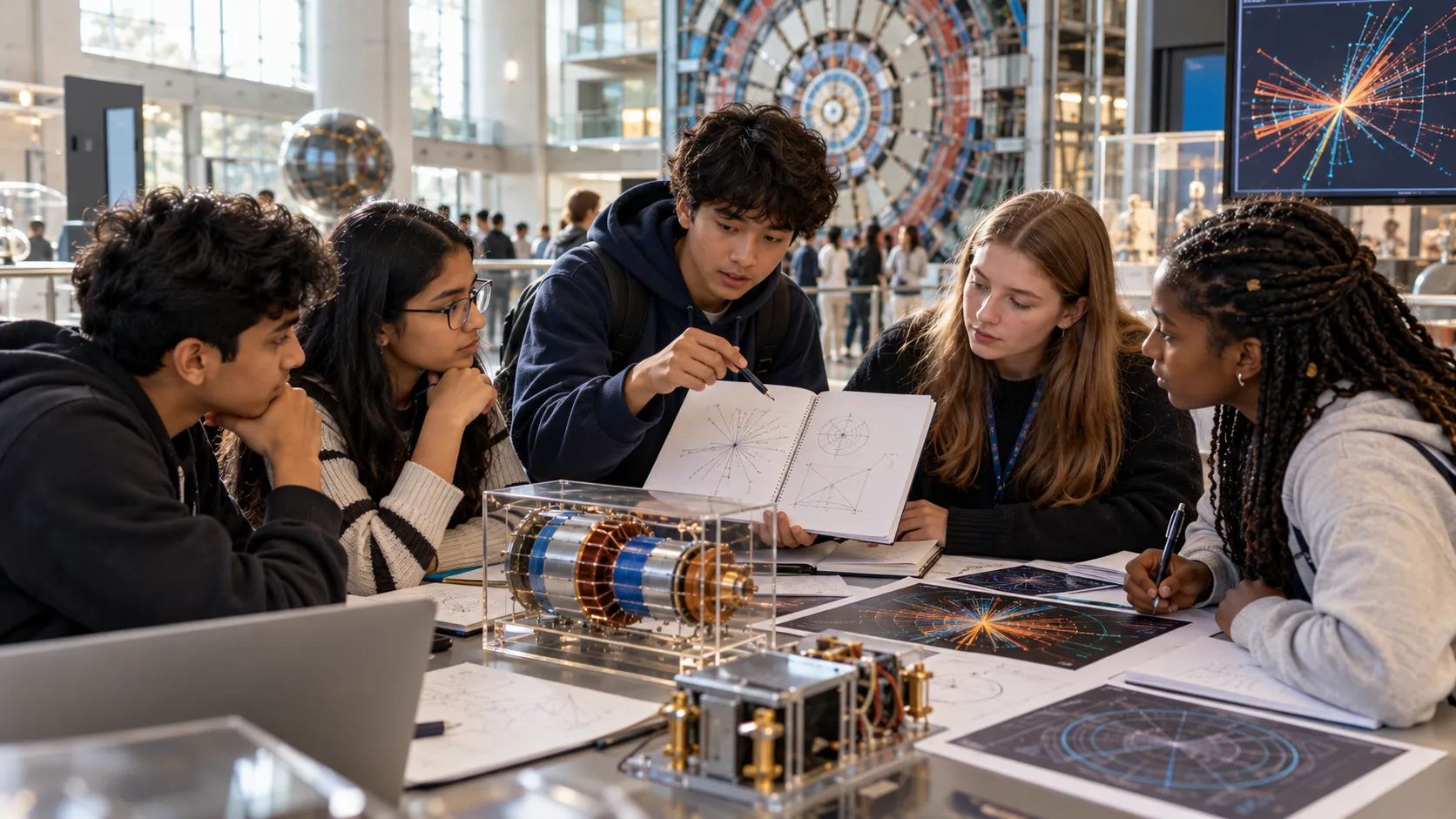
A visit to CERN can help students understand how scientists investigate the fundamental building blocks of matter, test theories about the universe and develop the complex technologies required for particle physics. Through exhibitions, guided tours and age-appropriate workshops, students can explore particle accelerators, detectors, antimatter and the relationship between theoretical predictions and experimental evidence.
Located near Geneva on the Swiss-French border, CERN is the European Organization for Nuclear Research. Its work provides a real-world connection to topics students encounter in physics, mathematics, computing and engineering. A visit is not simply an introduction to a famous scientific institution. It can help students understand how scientific questions become research projects and why some of the most important questions in physics remain unresolved.
The activities available depend on the group, age, booking and institutional arrangements. A CERN visit should therefore be planned around confirmed educational sessions rather than assumed access to restricted research facilities.
What is CERN, and why is it important for science education?
CERN conducts research into the fundamental structure of matter and the forces that govern interactions between particles. Its scientists use particle accelerators and detectors to investigate questions that cannot be answered through ordinary observation alone.
According to CERN’s official physics overview, the research programme covers subjects ranging from the Standard Model of particle physics to antimatter and cosmic rays. The Standard Model describes fundamental particles and the interactions through which they form the matter studied in particle physics.
For students, CERN offers a way to see how established scientific knowledge and open research questions coexist. Scientists have developed powerful models to explain particle behaviour, yet questions remain about topics such as dark matter, the imbalance between matter and antimatter, and how gravity fits into a broader understanding of nature.
This makes CERN particularly relevant to students studying physics at secondary-school or university level. Rather than presenting science as a finished body of information, the visit can demonstrate how researchers test predictions, evaluate evidence and refine explanations.
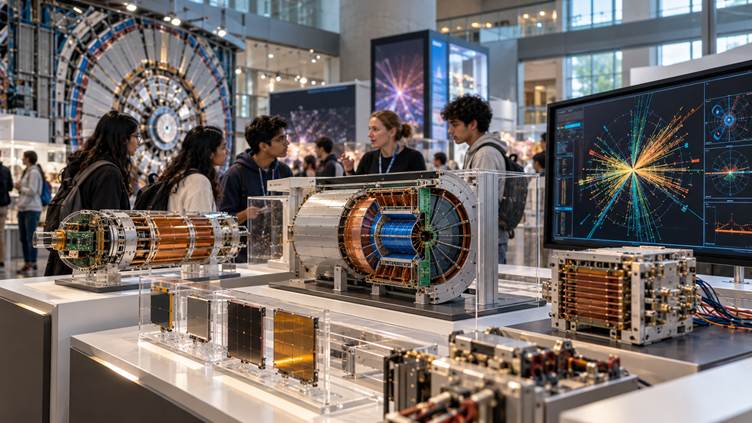
What is particle physics, and how can students understand it?
Particle physics investigates the smallest known constituents of matter and the interactions that govern their behaviour. Atoms contain electrons and a nucleus, while protons and neutrons are themselves composed of smaller particles called quarks. Electrons and quarks belong to the family of elementary particles studied in particle physics.
The Standard Model organises the known elementary particles and describes three of the four fundamental interactions: electromagnetic, weak and strong. Gravity is not incorporated into the Standard Model in the same way, which is one reason physicists continue to investigate deeper theoretical questions.
A CERN educational visit can help students connect these ideas to actual research. Exhibitions and explanations make it possible to explore how scientists infer the properties of particles from experimental measurements, rather than attempting to observe every particle directly.
For students who have previously studied atomic structure, this is an opportunity to move beyond diagrams in a textbook. They can investigate how scientists design experiments, why detectors need sophisticated instrumentation and how large quantities of data help researchers identify meaningful patterns.
Teachers can make the experience more productive by introducing a few concepts before departure. Students do not need advanced university-level mathematics to appreciate the central question: how can scientists learn about objects too small to see directly?
What can students learn about the Large Hadron Collider?
The Large Hadron Collider (LHC) is one of CERN’s best-known research instruments. It accelerates particles to very high energies and brings them into collision so researchers can investigate the resulting interactions.
Students can use the LHC as a case study in applied physics and engineering. The machine requires systems that accelerate and guide particles, maintain specialised operating conditions and collect measurements from complex detectors.
A classroom discussion can begin with a simple question: why do physicists accelerate particles before colliding them? The answer introduces the relationship between energy and the conditions needed to study fundamental interactions. Higher collision energies allow researchers to investigate phenomena that would not be accessible through lower-energy experiments.
Students can also examine the role of detectors. A collision produces evidence that must be measured and interpreted. Researchers analyse patterns in the recorded data to test hypotheses about what occurred.
A visit does not necessarily include access to the accelerator tunnel or active research areas. Students can nevertheless learn about the scientific purpose and engineering complexity of the LHC through suitable exhibitions and confirmed visitor activities.
How does CERN connect physics with engineering and computing?
Particle physics depends on much more than theoretical knowledge. Researchers need sophisticated instruments, reliable control systems and computing infrastructure to collect and analyse experimental results.
Students interested in engineering can investigate how precision components work together in a large research system. Those interested in computer science can explore the importance of data processing, simulation and collaboration across research teams.
Mathematics provides the language for modelling particle behaviour and evaluating experimental measurements. Engineering turns scientific requirements into functioning equipment, while computing helps researchers interpret the information produced by experiments.
This makes CERN useful for interdisciplinary learning. A school can connect a physics visit with discussions about mechanical engineering, electronics, software development and the international organisation of scientific research.
What happens during a CERN educational visit?
CERN’s public visitor facilities are designed to make aspects of its research accessible to different audiences. The CERN Science Gateway offers interactive exhibitions, science shows, guided tours and laboratory workshops, depending on the programme and availability.
Its exhibitions include Discover CERN, Quantum World and Our Universe. These provide different entry points into particle physics, quantum concepts and our understanding of the cosmos.
The experience should be selected according to the students’ age and preparation. Younger visitors may benefit from interactive explanations that introduce scientific ideas without requiring extensive prior knowledge. Older secondary-school students can engage with more detailed discussions of particle interactions, experimental design and the scientific questions behind CERN’s research.
CERN also provides an exhibition guide for educators, with information about exhibits suitable for primary and secondary-school groups. Teachers can use these resources to connect the visit to classroom topics and identify the exhibits most relevant to their students.
The format matters. An interactive exhibition, a guided tour and a laboratory workshop are different experiences. Schools should check which activities are available and confirmed for their group before departure.
Can students enter CERN laboratories or see the LHC tunnel?
Not necessarily. A CERN visit does not automatically include access to active laboratories, restricted engineering facilities or the LHC tunnel.
CERN’s official group-visit information describes guided tours lasting approximately two to three hours for groups of 12 to 48 participants, with a recommended age of 14 and above. The programme is adapted to the group, subject to operational and safety constraints.
Schools should therefore distinguish between learning about the LHC, viewing accessible facilities and entering restricted areas. These are not interchangeable experiences.
For educational planning, the most useful question is not whether students will enter a particular room. It is what they will be able to understand through the activities that are actually confirmed.
A well-prepared visit can still provide significant learning through exhibitions, explanations, workshops and discussions about the research process.
How should teachers prepare students for a CERN visit?
Preparation makes complex scientific subjects easier to approach. Before travelling, teachers can introduce atomic structure, elementary particles and the idea that scientific models are tested against experimental evidence.
Students could research one question each, such as how particle detectors work, why scientists study antimatter or what the Higgs boson contributes to our understanding of particle physics. Each student can then look for relevant information during the visit.
During the experience, students should record observations and questions. They can identify unfamiliar concepts, sketch an instrument or explain how a scientific question is connected to the equipment used to investigate it.
After the visit, teachers can ask students to prepare a short explanation of one concept for a younger audience. This helps reveal whether they understood the idea or simply recognised the terminology.
The activity also creates a bridge between the trip and the curriculum. Physics teachers can focus on particle interactions and experimental evidence, while computing or engineering students can explore the technical systems that support research.
How do you plan a CERN visit for an Indian school group?
The first step is to establish the academic purpose, student age range, group size and preferred dates. CERN’s booking rules should then guide the wider travel plan.
For groups of 12 to 48 visitors, CERN states that registration is mandatory and can be made up to nine months in advance. Its official group-booking guidance also states that requests for school and university visits must be submitted using the institution’s official email address. Requests from tour operators are not accepted in place of the school’s own registration.
The school should confirm its CERN visit directly through the official process before treating the session as secured. The broader travel itinerary can then be organised around the confirmed date, with time allocated for transport, accommodation and other educational activities.
For Indian schools, the planning process should also include passport and Schengen visa requirements, travel insurance, supervision, accessibility and contingency arrangements. Visa requirements and processing times should be checked through the relevant official channels.
A Europe-based science tour can combine CERN with complementary experiences, provided the route allows sufficient time for each visit.
Picknic’s Europe STEM and Culture programme includes a CERN visitor session alongside automotive engineering museums and other European destinations. The programme describes the CERN component as a visitor session, not a guaranteed laboratory class or unrestricted research-facility visit.
Schools can use the Picknic educational travel overview to explore available learning journeys and discuss their own objectives.
Frequently asked questions
Is CERN suitable for secondary-school students?
Yes. CERN offers visitor experiences for different age groups. Interactive exhibitions can introduce fundamental concepts, while certain guided tours and workshops have age, group-size and booking requirements. Teachers should select activities appropriate to the students’ preparation.
Is the CERN visit free?
CERN states that visits to the Science Gateway and its educational visitor activities are free, but registration is required and availability varies by activity. Schools should consult the official website for current booking conditions.
How far in advance should schools book CERN?
For groups of 12 to 48 visitors, CERN permits registration up to nine months in advance and recommends early booking because demand is high. Schools should wait for confirmation before making firm travel and accommodation arrangements.
Will students meet CERN scientists?
That depends on the specific programme. Some activities are delivered by members of CERN’s scientific community, while other visits use exhibitions or guided explanations. Direct interaction with a particular scientist should not be assumed unless it is explicitly confirmed.
What should students know before visiting CERN?
A basic understanding of atoms, subatomic particles and scientific investigation is useful. Students do not need to master advanced particle physics beforehand. A few well-chosen questions and relevant classroom preparation can make the visit more meaningful.
Make particle physics relevant beyond the classroom
A CERN visit can help students understand how scientists investigate matter, develop complex instruments and test explanations about the universe. Its educational value is strongest when the visit is matched to the students’ academic level and supported by preparation and follow-up work.
For schools planning a broader European science journey, Picknic’s Europe STEM and Culture programme offers a starting point for combining CERN with engineering and scientific heritage experiences. Explore the educational travel programmes to discuss a trip shaped around your students’ learning objectives.
Primary keyword: what can students learn from CERN visit
Secondary keywords: CERN educational visits, particle physics learning
Suggested URL slug: /blog/what-can-students-learn-from-a-cern-visit/
Continue Reading
NASA education programs help students connect classroom science with real space missions, engineering challenges, Earth observation and scientific research. Depending on their age and the programme, students may investigate planetary environments, design and test engineering solutions, explore satellite data or work with mentors on research projects. For school groups, an educational visit built around NASA-related […]
Space centers inspire students by turning abstract science into something they can observe, question and apply. When students encounter spacecraft, explore the engineering behind a mission or build a robotic model, subjects such as physics, mathematics, computing and engineering become more tangible. STEM education through travel works best when a visit is connected to classroom […]