
Choosing the right atoll, the right villa, the right season. Our complete guide to a honeymoon that lives up to every expectation.
The argument usually starts at a wedding or on a family WhatsApp group. Someone announces a Kerala trip for December, “when the weather is good”, and I have to decide whether to let it go or begin the sermon. I usually begin the sermon. December Kerala is lovely and busy and roughly what the brochure promised. Monsoon Kerala — June through August, when the southwest monsoon makes landfall on the Kerala coast before it reaches anywhere else in India — is the actual place, running at full volume, at half the price, with most of the audience gone home.
I grew up partly in my grandmother’s house near Thrissur, so I should declare my bias immediately. The smell of the first rain hitting a hot terracotta roof is, for me, what other people mean by nostalgia. But the case for monsoon Kerala does not rest on my childhood. It rests on arithmetic and Ayurveda and the colour green.
Is it a good idea to visit Kerala during the monsoon?
Yes, if you choose the right Kerala. June to August is ideal for houseboats, Ayurvedic treatments, hill stations and waterfalls, with hotel rates dropping 30 to 50 per cent. It is the wrong season for beach swimming — the sea is rough and often flagged off — so build the trip inland and on the backwaters instead.
Start with the rain itself, because North Indian friends always imagine it wrong. This is not Mumbai’s grey siege. Kerala monsoon rain arrives in episodes — a bruised sky, forty minutes of theatrical downpour, then sunshine so clean the whole landscape looks freshly rinsed, because it is. You plan around it the way locals do: mornings out, afternoons under a roof with chai and pazham pori, the banana fritters that exist specifically to be eaten while watching rain.
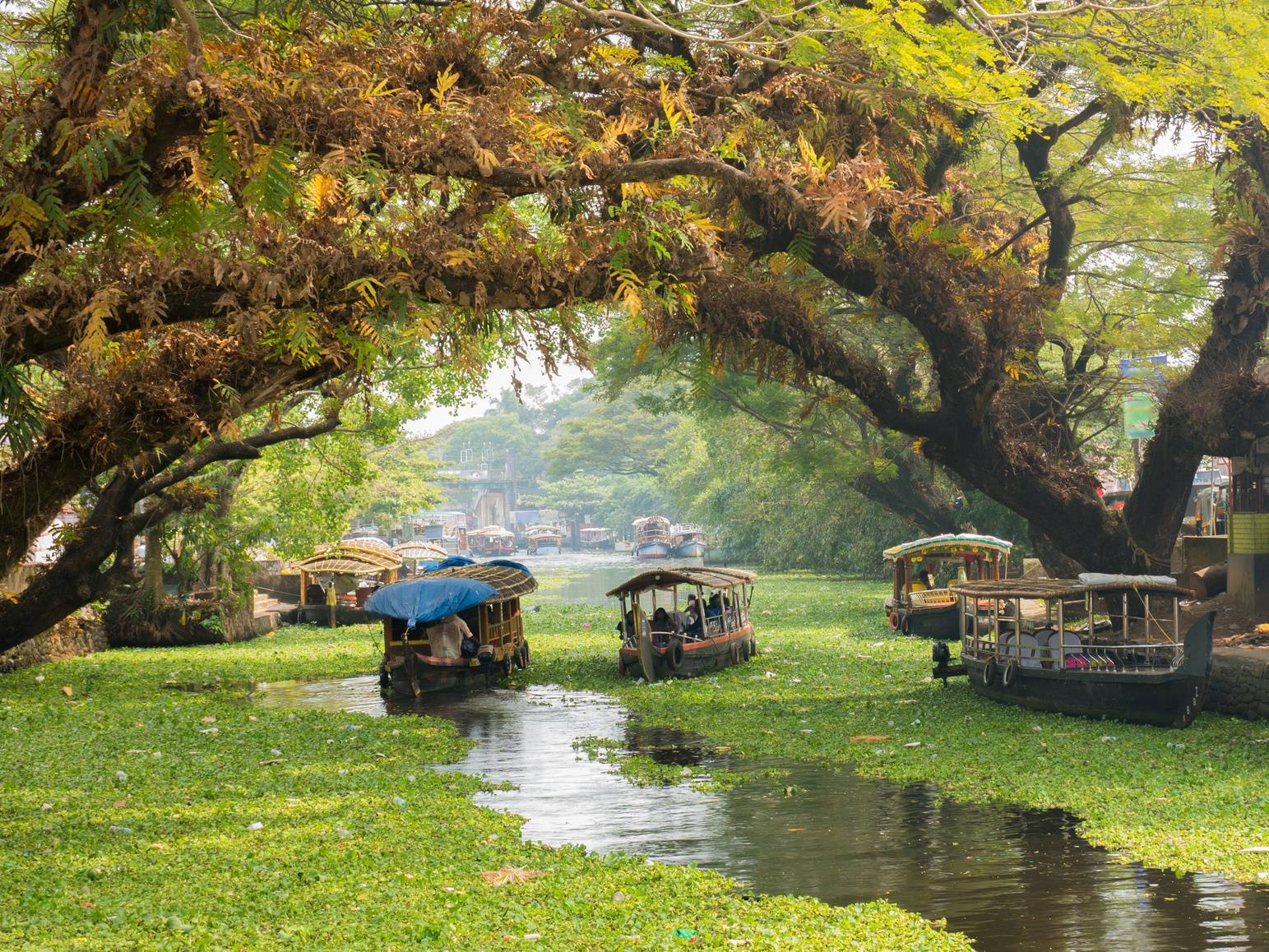
The backwaters are the monsoon’s main stage. A houseboat out of Alleppey in July moves through water that has risen into the paddy fields until the world is two greens and a waterline. Rain on a houseboat roof while you eat karimeen polichathu — pearl spot fish, masala-blistered, steamed in a banana leaf — is the single strongest argument I own for this season. The boat costs a good deal less than it did in December. The kingfishers do not seem to have noticed the discount.
Then there is the oldest reason of all. Karkidakam, the last month of the Malayalam calendar, falling in roughly mid-July to mid-August, is traditionally Ayurveda’s treatment season — the logic being that in cool, damp weather the body is most receptive to therapies. You do not have to accept the cosmology to notice the practical result: serious Ayurvedic centres run their best programmes now, and a proper seven-day treatment cycle costs meaningfully less than in peak season. My father, a sceptic of most things, did a monsoon panchakarma near Palakkad and has spoken of little else since.
The hills complete the argument. Munnar’s tea gardens in August are an implausible, video-game green, the estate paths smell of wet earth and eucalyptus, and Athirappilly — the waterfall the film industry cannot leave alone — goes from pretty to genuinely frightening, a brown-white wall of noise you feel in your chest from the viewing area. Wear sandals with grip. My canvas shoes died at Athirappilly in 2019 and were buried where they fell.
Now the honest caveat, delivered the way I deliver it on curator calls. The sea is not for swimming in these months — currents are dangerous, lifeguards will wave you out, and a beach-centred Kovalam holiday in July is a wet disappointment waiting to happen. Trekking routes sometimes close, leeches hold their annual conference in the wetter forests, and any given day’s plan needs a rain-flexible plan B. If your dream Kerala is sunbathing, book December and pay December prices with my blessing.
Pack like you mean it: a proper rain jacket rather than a hopeful umbrella, quick-dry clothes, grippy sandals, and one shawl for the hills, where Munnar evenings drop cooler than visitors expect. Add mosquito repellent without debate.
What monsoon Kerala offers, finally, is the thing this whole journal keeps circling: a place experienced on its own terms instead of the brochure’s. The crowds thin, the land turns the colour it is actually supposed to be, and you spend an afternoon doing nothing but watching rain move across a paddy field, which turns out not to be nothing at all.
Our Kerala monsoon journey strings this together — backwaters, an Ayurveda stay timed to the season, Munnar, and rain-proofed logistics. Travellers who fall for this register of green often graduate to our Ziro Festival journey in September, where the paddy fields come with a soundtrack.
Tell us whether you are a rain person or still deciding. Kerala in July has converted stronger sceptics than you.
ABOUT THE AUTHOR

Continue Reading